Broadcasting Gas Meter
iTron model EWQ-100GDLAS, new install in Massachusetts

Friend Patricia Burke let me know about her new Gas Meter, which was installed this week. She was on hand to watch the process and afterward recorded its RF emanations in this YouTube video.
Drumroll Please … (not!)
Patricia documents the constant drumbeat of RF pulsing generated by her new broadcasting Eversource Gas meter. From this video, we ascertain that every 15 seconds, like clockwork, this meter's internal antenna will generate a short 'chirp', followed two seconds later by a smaller chirp. All day, all night ... somewhat more than 10,0001 times per 24 hour period (8 times per minute, based on that sampling).
Each time the meter provides an audible click and the display shows a '1', this means that the received pulse has exceeded the upper measurement bound of the meter (the meter protects itself from over-exposure ... wouldn't it be great if people could!).
An Unnecessary and Often Injurious Stressor
Although the RF broadcast ‘chirp’ lasts only a few tens of milliseconds at a time, and generally aims away from the building, it is very strong and so may have biological impingement inside a residence. Some percentage of unlucky folks will see a steady erosion of their health because of this unnecessary stressor.
The health downsides attributable to a residential 'smart meter' such as this one have been reported throughout the world for nearly 20 years. Now, the heavy recent push to 'smarten' the Utility infrastructure in Massachusetts has already been taking its toll. I have provided a useful symptom tracker here.
Why Does the Gas Meter Seemingly Broadcast 5000+ Times Per Day?
So, what is it actually chirping about? Why does the Gas company insist there is no frequent broadcasting going on, even when as obvious as Patricia has documented?
It is frequently the case that there is a great deal of ‘overhead’ and redundancy in transmissions of this kind. In part, this is because complicated electronic devices have many software layers, only some of which are seen by the business (i.e., your utility usage info in the form of Standard Consumption Message packets).
Deeper software layers are often part of the networking infrastructure and so might involve packet exchange to synchronize clocks, to identify the topology of the mesh network and so on. We cannot tell from looking at the meter how its information travels to the Utility, thus what kind of overhead transmissions one should expect. The consumer will be exposed to all the layers of broadcasting.
Surfacing invisible hazards from utility meters by using RF meters is an important way we educate the public, from the bottom up (because education from the top down on this topic remains dysfunctional).
The FCC ID Leads to Additional Information
It is a requirement on broadcasting meters that they prominently show their ‘FCC ID’ in such places that no tools or disassembly are necessary to find it. Patricia found her FCC ID on the underside of the meter and passed it along to me.
An FCC ID is a key that opens many doors. With an FCC ID, we can identify:
Who manufactures this meter
When was it registered
How powerful is the RF transmission.
What frequencies are transmitted
Sometimes, we can also learn:
How it can be configured
What alternate antenna or broadcasting options exist
How often it generates transmissions of RF
How it works inside
Looking Up FCC ID ‘EWQ-100GDLAS’
Patricia’s picture was fuzzy, but I have seen this kind of gas meter before. It is a common deployment here in Massachusetts.
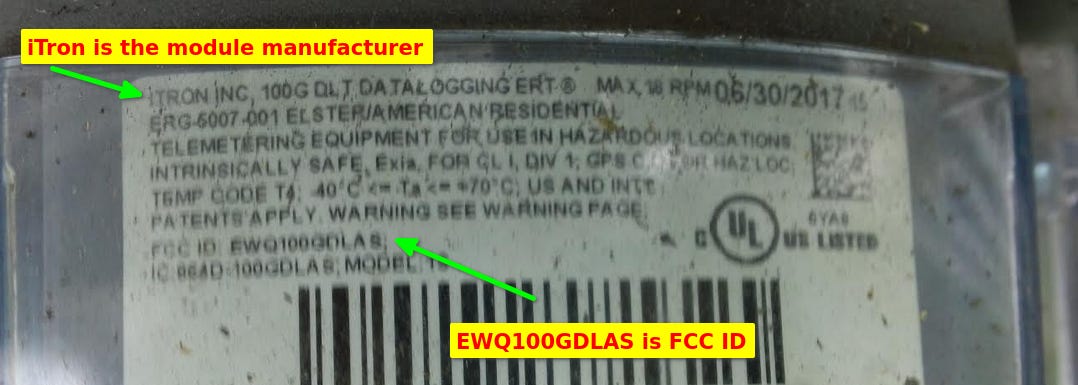
Employing a web search for the term FCC ID EWQ100GDLAS soon brought up a page of documents which were filed with the FCC, provided as evidence that this meter is not going to generate excessively powerful signals which might interfere with other devices. As is well known, these FCC exposure limits are not health-based for long-term human and pet exposure.
Note that the FCC does not test anything. Instead, the vendors must arrange for their RF-broadcasting devices and modules to be tested, verified and documented by FCC-approved testing labs. All of this documented evidence is submitted for FCC review and approval. Along the way, the most informative documentation is often marked as being ‘confidential’ and so are withheld from the public.
Look for the RF Exposure Report
Nearly every FCC filing includes a document listed as ‘RF Exposure’, usually summarizing all of the frequencies this device is capable of broadcasting and the maximum strength of signals at those frequencies.
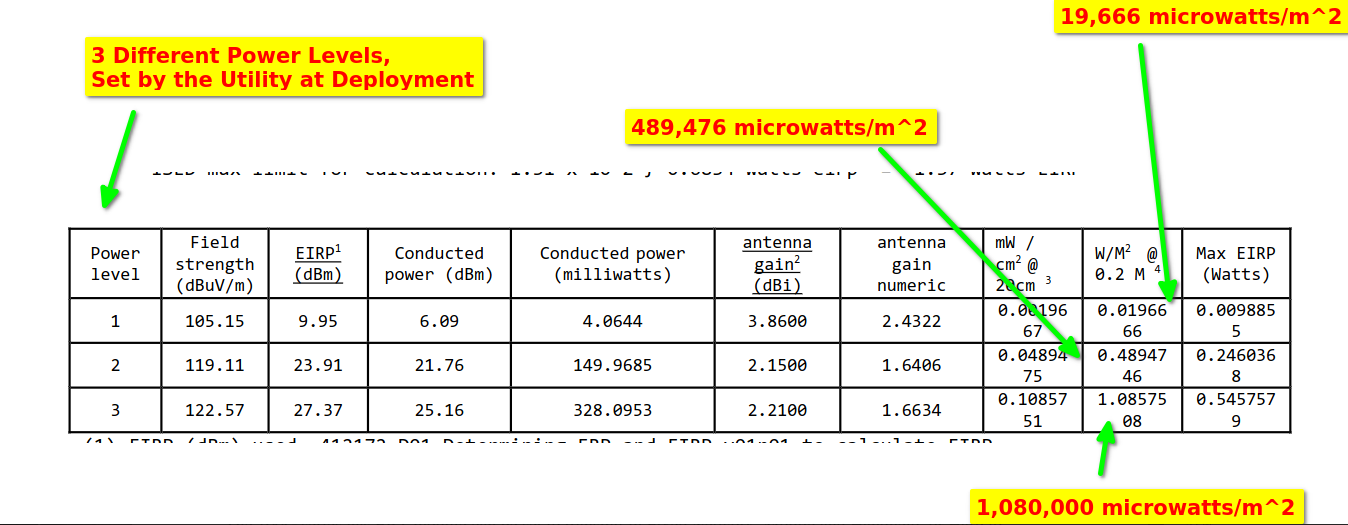
For this meter, the RF Exposure Report provides a juicy nugget of useful info — that this meter can be configured to broadcast using three different power levels. This is unusual among such meters. The most powerful power setting will blast at 1 million microwatts per meter-squared at at distance of 20 centimeters, a very strong signal, one that is approximately one third of the legal maximum (2.7 Watts/meter-squared).
It Could Be Worse …
We generally ascribe a worse biological impact to stronger RF signals, but biology is complicated and sometimes even whispering signals can have an outsized effect. A stronger signal will travel further so it may be an ill-aimed meter from one’s neighbor is the stronger source of RF misery.
Occasionally, there is information about how such a meter functions. We are lucky here that a few crumbs of information have slipped past the censors at the FCC. In the user manual, on page 9, is found this informative table about the Transmission Modes, including how strongly and how often the RF signals are produced.
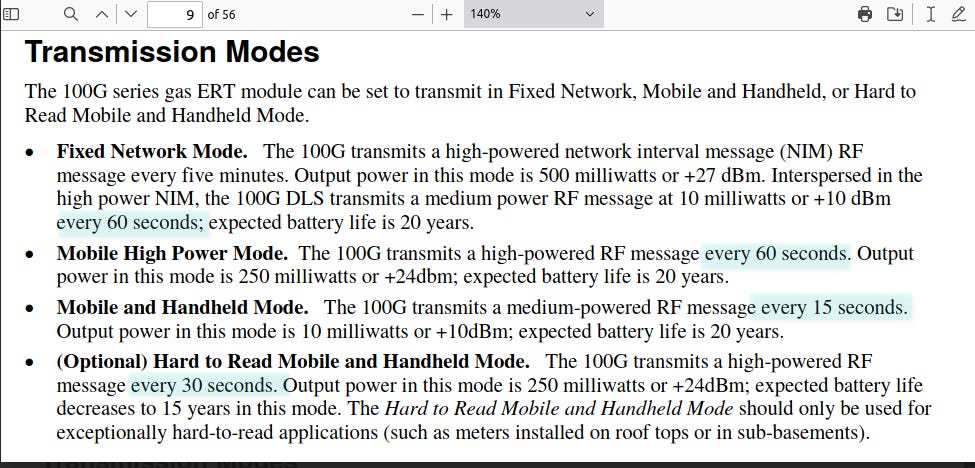
Patricia’s recording showed a repetition rate of 15 seconds, suggesting the Mobile/Handheld Mode is active, which operated at the lowest power mode. In fact, Patricia’s recording showed two overlapping 15 second repetitive pulses, where the first pulse is stronger than the second. This suggests either (a) an undocumented transmission (perhaps for networking overhead) or (b) that there is a second identical broadcasting meter nearby.
A Spectrum Analyzer is Needed In Noisy Environments
Patricia was able to use her Gigahertz Solutions HF35C directional broadband RF meter to document the emanations from this smart meter because her environment was otherwise rather ‘quiet’. In noisier environments, where cell phones, routers and such are all blathering, the measurements may be less conclusive.
Below, I show a spectrum analyzer set to record broadcast traffic from the same kind of gas meter, from a client engagement is a more congested environment. This utility meter broadcasts exclusively between 902-928 MHz, as is documented elsewhere among the FCC filings. I was standing about 20 centimeters away to record this information.
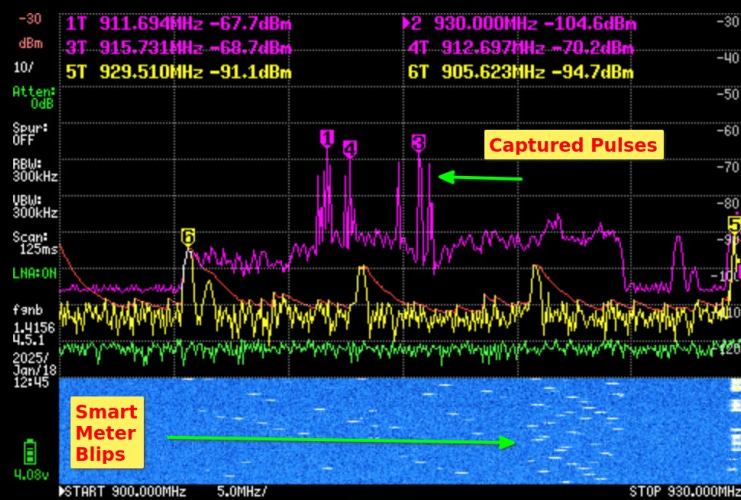
A bit of explanation is in order. The magenta trace represents that Maximum broadcast strength value encountered in the last minute or two — these were pulsed transmissions, ones that were not especially strong. At the bottom, the blue area captures the historic traffic over the last 10 seconds and each horizontal ‘hyphen’ represents part of a transmission, the brighter the ‘hyphen’ the stronger the signal received. This neighborhood was full of broadcasting meters!
So, Should Patricia Pay for an Opt-out for this Gas Meter?
Off-hand, the calculus suggests that this meter is apt to have small impingement on the interior living space, that any residence-entering broadcast signals could be significantly reduced by wrapping the gas meter in a few layers of aluminum foil (leaving the front face clear, as it aims away from the home) or purchasing a gas meter cover, and if there are multiple gas meters next to each other at this location, then all need to be similarly opted-out or shielded, otherwise there is no benefit for only a single one to be. However, for people who are already EMF-sensitized, the calculus might run differently.
We should never have had to be concerned about the ruination of one’s health from a simple utility usage meter, but that is the natural result of more than 7 decades of misrepresentation about the biological impact of pulsed, man-made RF radiation. At this point, the electrical engineers, their professors, the doctors and the utility personnel are all equally uninformed, and sometimes will be rudely dismissive of complaint. We must all see to our own personal safety until the concerns of wanton RF impingement follow the inevitable regulatory path of tobacco, lead, asbestos, and glyphosate.
We later learn that each of these gas meters seems to broadcast 4 times a minute, for a total of a bit more than 5000 times per day.
Thank you so much for sharing your wisdom Ken , and you are exactly correct....this is a duplex and there is another meter nearby.